
Colon Cancer Treatment in Delhi
Colon cancer is one of the most treatable cancers when detected early, with survival rates exceeding 90% in early stages. However, delayed diagnosis can significantly reduce treatment success.
If you are searching for colon cancer treatment in Delhi, choosing an experienced specialist and access to advanced colon cancer surgery in Delhi can make a critical difference in outcomes.
Dr. Deep Goel, recognised as one of the best colon cancer surgeons in Delhi, is a leading GI and laparoscopic surgeon at BLK-Max Super Specialty Hospital, New Delhi, bringing over 27 years of experience and 10,000+ surgeries to provide personalised, evidence-based colon cancer care focused on faster recovery and long-term survival.
👉 Book a consultation today to discuss your treatment options.
Introduction
Getting a colon cancer diagnosis is frightening. Most people don’t know where to start, what questions to ask, or whether treatment will actually work.
Here’s what you should know first: when colon cancer is found early and confined to the colon, the 5-year survival rate is above 90%. That number drops sharply when the diagnosis is delayed. In India, colorectal cancer accounts for over 64,000 new cases and nearly 38,000 deaths each year, and a big part of that mortality gap comes from late-stage detection.
The good news is that with better awareness and access to specialist care in Delhi, more patients are getting diagnosed and treated at stages where outcomes are genuinely good.
This guide walks you through everything from what colon cancer is to how it’s treated, what surgery actually involves, and what recovery looks like.
What Is Colon Cancer and How Does It Develop?
Colon cancer starts in the large intestine (the colon), which is an important part of your digestive tract. It almost always begins as small, non-cancerous growths called polyps on the inner lining of the colon. Most polyps are harmless. But some, if left undetected, slowly turn cancerous over the years.
Once cancerous cells form, they can grow through the colon wall, spread to nearby lymph nodes, and eventually reach other organs, such as the liver or lungs. That’s why removing polyps early, before they turn cancerous, is the entire logic behind colonoscopy screening.
What Are the Warning Signs of Colon Cancer?
Colon cancer often causes no symptoms in its early stages. By the time symptoms appear, the cancer has usually grown. That’s the core reason screening matters so much.
When symptoms do show up, the most common ones are:
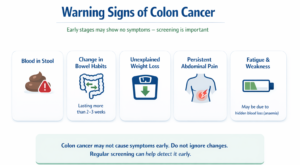
Don’t dismiss these as haemorrhoids or acidity. Many patients do, for months. If symptoms last longer than 2 weeks, get checked.
If you are noticing early warning signs, timely evaluation for colon cancer treatment in Delhi is crucial.
Colon Cancer Risk Factors: Who Is Most at Risk?
Colon cancer risk rises with age, but Indian patients tend to be diagnosed younger than their Western counterparts. A large audit from Tata Memorial Hospital found the mean age of Indian colorectal cancer patients was 47.2 years, compared to the mid-60s in the US. That’s a meaningful difference.
The key risk factors fall into two groups:
- Things you can change: A diet high in red or processed meat, low fibre intake, obesity, physical inactivity, smoking, and heavy alcohol use.
- Things you can’t change: Age above 50, a family history of colon cancer or polyps, inflammatory bowel disease (IBD) like Crohn’s disease or ulcerative colitis, and genetic syndromes like Lynch syndrome or familial adenomatous polyposis (FAP).
If you have a family member who has had colon cancer, you likely need screening earlier than the standard age of 45.
Colon Cancer Diagnosis in Delhi
Diagnosis involves several steps. It starts with a clinical examination and a review of your symptoms and family history.
- The colonoscopy is the most important test. A thin, flexible tube with a camera is passed through the colon to look for abnormal tissue. If something suspicious is found, a small biopsy is taken on the spot.
- After a cancer is confirmed, staging tests follow: a CT scan of the abdomen and pelvis to check how far the cancer has spread, a CEA blood test (a tumour marker), and in some cases, a PET scan. Understanding which stage you’re at determines everything about your treatment plan.
You can watch Dr. Goel’s patient education videos for a detailed explanation of what these tests involve and when each one is needed.
Colon Cancer Treatment Options in Delhi (Stage-wise Guide)
Colon cancer treatment depends on the stage at diagnosis. Colon cancer surgery in Delhi is the primary treatment in most cases, often combined with other therapies.
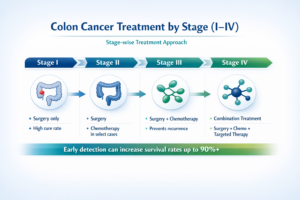
Stage I
- Surgery alone is usually sufficient
- Removal of the tumour with surrounding tissue and lymph nodes
Stage II
- Surgery remains the main treatment
- Chemotherapy may be considered in high-risk cases
Stage III
- Surgery followed by adjuvant chemotherapy (commonly ~6 months)
- Helps reduce the risk of recurrence when lymph nodes are involved
Stage IV
- Combination of treatments including surgery, chemotherapy, targeted therapy, and immunotherapy
- Treatment is individualised based on the spread and the patient’s condition
As part of GI cancer surgery in Delhi, Dr. Deep Goel tailors every treatment plan to the individual patient, not just the stage. That includes choosing between open surgery, laparoscopic, or robotic-assisted approaches based on the tumour location and the patient’s overall health.
Note: Discuss Your Colon Cancer Treatment Options in Delhi with Dr. Deep Goel.
Life After Colon Cancer Surgery: What to Expect
Most patients undergoing minimally invasive surgery stay in the hospital for 3 to 5 days. The first few weeks involve a gradual return to a normal diet, some fatigue, and limited physical activity.
A stoma (an opening in the abdomen to redirect waste into a bag) is sometimes needed, usually temporarily, while the bowel heals. It’s not required in every case.
Follow-up after surgery includes regular blood tests, colonoscopies at set intervals, and imaging scans to check for recurrence. For Stage III patients, chemotherapy starts around four to eight weeks after surgery.
For a clear picture of what treatment costs involve, see the colon cancer surgery cost in India page, which breaks down expenses by procedure type and hospital stay.
Recovery is gradual. Most patients return to daily activities within four to six weeks after minimally invasive surgery.
Why Choose Dr. Deep Goel For Colon Cancer Treatment in Delhi?
Choosing the right specialist can significantly impact treatment success and recovery. With colon cancer, experience, precision, and personalised care are critical at every stage.
Dr. Deep Goel is widely recognised for his expertise in advanced GI and colorectal cancer surgery in Delhi, offering patients a combination of clinical excellence and patient-focused care.
What Sets Him Apart:
- 27+ years of experience in gastrointestinal and cancer surgery
- 10,000+ successful surgeries, including complex colorectal procedures
- Expertise in laparoscopic and robotic-assisted colon cancer surgery
- International training from leading centres in the UK, USA, and France
- Works within a multidisciplinary cancer care team for comprehensive treatment planning
- Focus on minimally invasive techniques for faster recovery and better outcomes
Dr. Goel’s approach goes beyond just treating the disease; he focuses on early diagnosis, precise surgical intervention, and long-term patient well-being.
Take the First Step Towards Early Diagnosis and Better Outcomes
Colon cancer is highly treatable when detected early, but delays in diagnosis can significantly impact survival. The difference between early-stage and advanced-stage outcomes is substantial, and timely action can save lives.
If you are experiencing symptoms, have a family history, or have been recently diagnosed, getting the right expert opinion early is crucial. With advanced treatment options and experienced specialists available in Delhi, you have access to care that can make a real difference.
👉 Don’t wait for symptoms to worsen. Early consultation gives you more treatment options and better outcomes.
📞 Book Colon Cancer Consultation with Dr. Deep Goel
Take control of your health today with expert guidance and personalised care.
Frequently Asked Questions
What is the cost of colon cancer surgery in Delhi? expand_more
The colon cancer surgery price in Delhi depends on the stage of cancer, the type of hospital, and the treatment approach. Average cost range is ₹ 6,40,000 – ₹ 12,80,000.
Is laparoscopic surgery available for colon cancer in Delhi? expand_more
Yes. Dr. Deep Goel performs minimally invasive laparoscopic and robotic-assisted colectomy at BLK-Max Super Specialty Hospital. These approaches result in smaller incisions, less pain, shorter hospital stays (3–5 days), and faster return to daily activity compared to open surgery.
Will I need a colostomy bag after colon cancer surgery? expand_more
Not necessarily. A stoma is sometimes required to allow the bowel to heal after surgery, but it is often temporary. Whether a stoma is needed depends on the tumor location, stage, and surgical approach. Dr. Goel discusses this in detail during pre-surgical consultation.
How long does recovery take after colon cancer surgery? expand_more
Most patients undergoing minimally invasive surgery are discharged in 3-5 days. A full return to daily activities typically takes 4-6 weeks. Stage III patients begin adjuvant chemotherapy 4-8 weeks post-surgery.
What not to eat with colon cancer? expand_more
Usually, it is suggested to avoid or limit red and processed meats, alcohol, fried/fatty foods, sugary or ultra-processed foods, and gas-producing items. After surgery, avoid raw and high-fibre foods initially.

Dr. Deep Goel’s Medical Content Team
Dr. Deep Goel’s medical content team specialises in creating accurate, clear, and patient-focused healthcare content. With strong clinical understanding and expertise in technical writing and SEO, the team translates complex medical information into reliable, accessible resources that support informed decisions and uphold Dr. Goel’s commitment to quality care.
This content is reviewed by Dr. Deep Goel
Related Conditions

Colon Cancer Treatment in Karol Bagh
A colon cancer diagnosis can be overwhelming for patients and their families. Along with physical symptoms, it often brings emotional…
Blood and Mucus in Stool: Causes, Symptoms, Diagnosis and Treatment
Seeing blood and mucus in stool can be worrying. Sometimes it happens because of a common problem such as piles, constipation or…
Related Blogs
White Mucus in Stool: Causes, What It Means & When to See a Doctor
Have you noticed a white, clear or jelly-like substance in your stool and wondered, “Is…
Read Article →
Life After Colorectal Cancer Surgery: What to Expect
If you or a loved one has recently undergone surgery for colon cancer or rectal…
Read Article →
Colon Cancer Symptoms: Early Signs Most People Ignore
Colon cancer is one of the most common gastrointestinal cancers in India, yet it remains…
Read Article →
What to Expect Before, During, and After Colostomy Surgery?
Colostomy surgery, a life-saving procedure, involves rerouting the colon to create a stoma, allowing waste…
Read Article →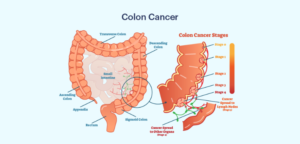
Colon Cancer Surgery: What You Need to Know?
In 2020, colon cancer emerged as the third most widespread cancer globally, affecting more than…
Read Article →
What Should You Eat Post-Colorectal Surgery?
Colorectal surgery is a procedure to remove a blocked or unhealthy part of the large…
Read Article → WhatsApp