
Whipple Procedure in Delhi
The Whipple procedure, also called pancreaticoduodenectomy, is a complex surgery used primarily to treat cancers and selected tumours of the head of the pancreas, bile duct and duodenum. For patients looking for Whipple surgery in Delhi or Delhi NCR, treatment planning should involve an experienced gastrointestinal (GI), hepatopancreatobiliary (HPB) or pancreatic surgeon and a multidisciplinary team.
At Dr. Deep Goel’s Practice, patients can undergo evaluation for Whipple surgery for pancreatic cancer and other conditions affecting the pancreas and surrounding organs, with treatment planned according to tumour location, stage, vascular involvement and overall health.
In this page, we’ll explain the Whipple procedure in simple terms: why it’s done, who needs it, how it connects to digestive issues, and what recovery looks like. Whether you’re going through this yourself or helping someone else, this guide will give you the clarity you need.
Reach Out for Expert Care
What is The Whipple Procedure?
- Medical name: Pancreaticoduodenectomy
- Main use: Surgery for selected pancreatic and periampullary cancers
- Common approach: Open surgery; minimally invasive or robotic approaches may be suitable in selected patients
The Whipple procedure is a major surgical operation that involves the removal of the head of the pancreas, part of the small intestine (duodenum), the gallbladder, and the bile duct. In some cases, a portion of the stomach may also be removed.
This procedure is primarily used to treat cancers and tumours located in the pancreas and nearby organs. After removing the affected organs or tissues, the surgeon reconnects the remaining organs so that digestion can continue as normally as possible.
When Is Whipple Surgery Recommended?
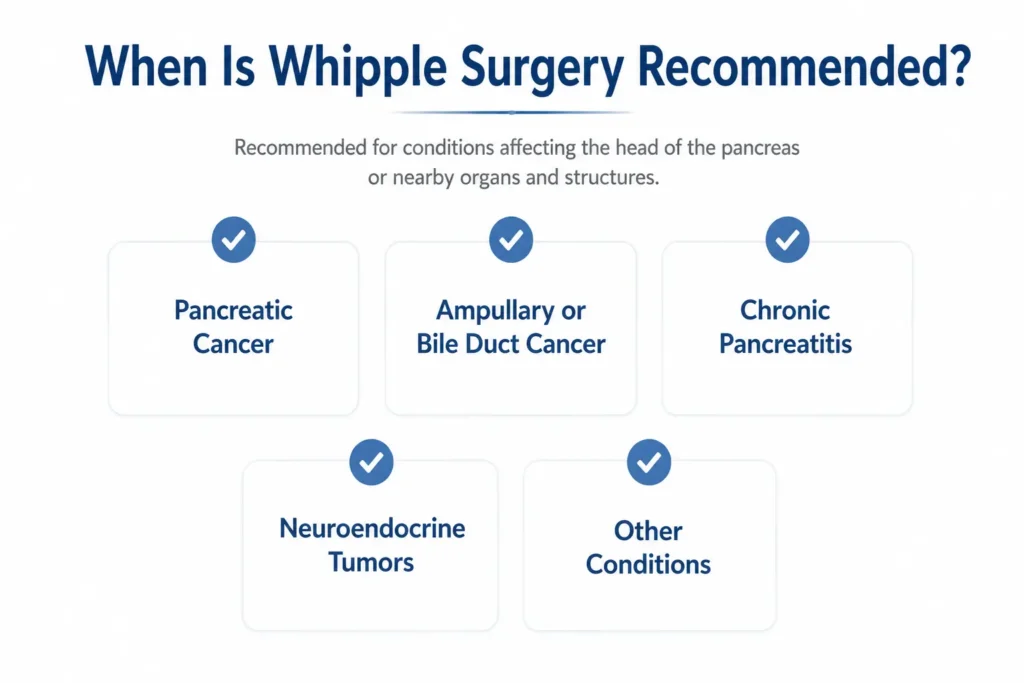
Whipple surgery is typically recommended in the following situations:
1. Pancreatic Cancer
The most common indication is Whipple surgery for pancreatic cancer, mainly when the tumour is located in the head of the pancreas. If the cancer is detected early and hasn’t spread beyond the pancreas, the Whipple procedure can significantly improve survival chances.
2. Ampullary Cancer
This cancer occurs where the bile duct and pancreatic duct meet and empty into the small intestine. The Whipple operation can effectively remove this region and nearby tissues to stop the spread.
3. Chronic Pancreatitis
In some severe cases of chronic inflammation of the pancreas that do not respond to medications or less invasive treatments, the Whipple procedure may be considered to reduce pain and complications.
4. Neuroendocrine Tumours
Non-cancerous but potentially dangerous growths in the pancreas may also necessitate surgery to prevent future complications.
Read More – Neuroendocrine Tumor Treatment
5. Bile Duct Cancer or Trauma
If the bile duct is affected by cancer or traumatic injury, and the nearby organs are involved, this surgery can help restore functionality.
Dr. Deep Goel states, “Pancreatic and periampullary cancers often go undetected until late. At our centre, we emphasise early detection and timely surgical intervention like the Whipple procedure to give patients the best survival outcomes.”
Read More – Bile duct cancer Treatment
How Is the Whipple Procedure Performed?
This is a highly complex, time-intensive surgery that usually lasts 5-8 hours. It is performed by a surgical oncologist or hepatopancreatobiliary (HPB) surgeon with specialised expertise.
There are three main types of Whipple procedures:
- Traditional (Open) Surgery: The surgeon makes a large incision in the abdomen.
- Laparoscopic (Minimally Invasive): Small incisions with a camera-guided tool.
- Robotic-Assisted Surgery: A more advanced minimally invasive approach with high precision.
Steps Involved:
- Removal of the pancreas head, duodenum, bile duct, gallbladder, and sometimes part of the stomach.
- Reconstruction by connecting the remaining pancreas, bile duct, and stomach to the small intestine to ensure normal digestion.
Dr. Deep Goel adds, “Whipple surgery demands surgical precision due to the complex anatomy involved. Our focus is on achieving a cancer-free margin while preserving maximum organ function. That’s the key to a successful long-term outcome.”
Recovery After Whipple Surgery
1. Hospital Stay
Patients typically stay in the hospital for 7 to 14 days. During this period:
- Pain is managed through IV medications.
- A feeding tube may be placed temporarily.
- Regular monitoring ensures that there are no signs of infection or leakage from surgical connections.
2. Immediate Recovery
The first few days post-surgery are critical. Patients are slowly transitioned from liquid diets to soft foods. Movement is encouraged to prevent blood clots.
3. Long-Term Recovery
Full recovery from the Whipple procedure may take 6 weeks to 6 months, depending on factors such as age, overall health, and the presence of post-operative complications.
Life After the Whipple Procedure
Recovery requires both patience and close medical follow-up. Here are some key recommendations:
a) Nutritional Adjustments
- Patients may struggle to digest fats or certain types of food
- Small, frequent meals rich in protein and low in fat are advised
- Pancreatic enzyme supplements may be needed to aid digestion
b) Monitoring Blood Sugar
The pancreas also regulates insulin. After Whipple surgery, some patients may experience changes in blood sugar levels or develop diabetes temporarily or permanently.
c) Physical Activity
Light physical activity, such as walking, can help reduce the risk of complications like pneumonia or deep vein thrombosis (DVT).
d) Emotional Support
The physical and emotional toll can be significant. Professional counselling and patient support groups help patients and families cope during this transition.
A patient of Dr. Goel stated, “I was diagnosed with a tumour in the head of the pancreas after months of acid reflux and unexplained weight loss. I was referred to Dr. Deep Goel, and he performed the Whipple surgery successfully, and I was walking by day 3. It’s been 9 months now, and I’m cancer-free, living normally.”
Whipple Operation Success Rate
The Whipple operation’s success rate has improved significantly due to advances in surgical techniques and post-operative care.
- Hospital Volume Matters: Patients treated at high-volume cancer centres tend to have better outcomes due to the expertise of experienced surgical teams.
- Survival Rates: For early-stage pancreatic cancer, the 5-year survival rate after successful Whipple surgery can range from 20% to 25%, compared to just 1–3% without surgery.
- Post-Surgical Quality of Life: Many patients can return to a near-normal life with proper diet, medications, and regular monitoring.
Reach Out for Expert Care
Whipple Surgery Cost in India
India has become a preferred destination for patients worldwide seeking advanced cancer surgeries at a fraction of the cost in Western countries.
The Average Cost of Whipple Surgery in India ranges from ₹3,50,000 to ₹6,50,000 in top hospitals. Key factors that affect cost include the type of hospital, the use of the technique, the length of hospital stay, and post-surgical complications, among others.
Click here to read More about surgery cost – Pancreatic Cancer Surgery Cost in India
Patients benefit from high-quality treatment, experienced surgeons, and cost-effective packages, making India a preferred choice for Whipple surgery.
Another patient who travelled from Dubai to India shared, “I flew to India after my doctors found a suspicious mass near my bile duct. Dr. Deep Goel explained everything about the Whipple surgery in detail. The operation went smoothly, and the international patient team made the entire experience stress-free. I am now back in Dubai, feeling stronger every day.”
Risks and Complications Associated With the Whipple Procedure
Like any major surgery, especially one involving multiple organ systems, the Whipple procedure comes with potential risks:
Immediate Risks:
- Bleeding
- Infection
- Leakage at the surgical connections
- Delayed gastric emptying
- Blood clots
Long-Term Risks:
- Nutritional deficiencies
- Weight loss
- Pancreatic insufficiency
- Onset of diabetes
- Bile reflux
Life After the Whipple Procedure
Patients who successfully undergo Whipple surgery often describe it as a turning point in their cancer journey. Although lifestyle changes are inevitable, they can lead to a productive, fulfilling life with the proper care plan.
Follow-up Schedule:
- Frequent doctor visits in the first year (monthly or quarterly)
- Routine CT scans, blood work, and tumour marker tests
- Monitoring for cancer recurrence or new symptoms
Lifestyle Adjustments:
- Healthy, nutrient-rich diet
- Avoiding alcohol and smoking
- Stress management and moderate exercise
Dr. Deep Goel shares, “We believe in empowering our patients. Before surgery, every individual and their family are educated about the Whipple procedure, its risks, recovery, and lifestyle changes. Informed patients recover better; they become active participants in their healing.”
How to Choose a Whipple Surgeon in Delhi?
When choosing a Whipple surgeon in Delhi, consider their experience with pancreatic and HPB surgery, experience performing complex pancreatic cancer operations, and access to multidisciplinary cancer care. It is also important to consider the surgeon’s experience with appropriate surgical approaches, including open, laparoscopic or robotic Whipple surgery, depending on the patient’s condition.
Dr. Deep Goel is Vice Chairman & HOD of Surgical Gastroenterology at BLK-Max Super Speciality Hospital, New Delhi. He has 27+ years of experience and has performed 20,000+ GI surgeries, including complex pancreatic and hepatobiliary cancer surgeries, with expertise in advanced laparoscopic and robotic GI procedures.
Patients from Delhi, Noida, Gurugram (Gurgaon), Ghaziabad and Faridabad can consult Dr. Deep Goel in Delhi for specialist evaluation and personalised treatment planning for pancreatic and hepatobiliary conditions.
Final Thoughts
The Whipple procedure remains the most effective surgical option for selected pancreatic and periampullary cancers. While it is a complex operation with a structured recovery process, appropriate patient selection, experienced surgical care, and long-term follow-up can lead to meaningful survival and quality-of-life outcomes.
Patients considering Whipple surgery in Delhi can consult Dr. Deep Goel to understand their suitability for surgery, treatment options, potential risks and expected recovery.

Dr. Deep Goel’s Medical Content Team
Dr. Deep Goel’s medical content team specialises in creating accurate, clear, and patient-focused healthcare content. With strong clinical understanding and expertise in technical writing and SEO, the team translates complex medical information into reliable, accessible resources that support informed decisions and uphold Dr. Goel’s commitment to quality care.
This content is reviewed by Dr. Deep Goel
 WhatsApp