
Colon Cancer Symptoms: Early Signs Most People Ignore

Colon cancer is one of the most common gastrointestinal cancers in India, yet it remains one of the most underdiagnosed. The reason is simple, its early symptoms are easy to miss. Bloating, mild constipation, occasional blood in stool, most people think of these as diet or stress issues and move on.
That delay is what makes colon cancer dangerous.
Understanding the symptoms of colon cancer, at every stage and in both men and women, can be the difference between catching it when it is curable and discovering it when options are limited. This blog breaks it all down clearly.
Reach Out for Expert Care
Early Symptoms of Colon Cancer
In early-stage colon cancer, most people feel nothing at all, which is exactly why routine colorectal screening is so strongly recommended after age 45.
When symptoms do appear in the early stages, they tend to be easy to overlook:
- A persistent change in bowel habits, such as looser stools or constipation that lasts more than a few weeks
- A feeling that the bowel has not fully emptied after a bowel movement
- Thin or ribbon-like stools that appear without an obvious dietary explanation
- Small amounts of bright red or dark blood in the stool
- Mild abdominal discomfort, cramping, or gas that keeps returning
- Unexplained tiredness or low energy, often caused by slow internal bleeding leading to anaemia
None of these symptoms alone confirms colon cancer, but any one of them persisting beyond two to three weeks deserves medical attention.
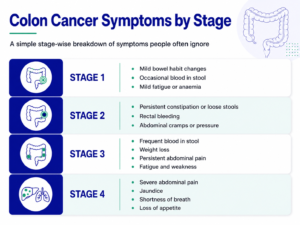
Stage 1 and Stage 2 Colon Cancer Symptoms: When the Cancer Is Still Local
Stage 1 and Stage 2 colon cancer are both considered localised disease, meaning the cancer has not yet reached distant lymph nodes or organs.
At Stage 1, the tumor is confined to the innermost layers of the colon wall.
When Stage 1 colon cancer is caught, it is almost always through a routine colonoscopy, not because the patient noticed something wrong. Occasional faint blood in stool or mild fatigue from low-grade anaemia are the only symptoms some patients report, and even these are easy to dismiss.
At Stage 2, the tumor has grown through the colon wall and may have reached surrounding tissue, but lymph nodes remain clear.
This is where symptoms start becoming slightly harder to ignore, though many patients still attribute them to diet or stress:
- Bowel habit changes that persist beyond two to three weeks, alternating between constipation and looser stools
- A consistent feeling of incomplete bowel emptying
- Rectal bleeding or blood mixed into stool
- Mild but recurring abdominal pressure
- Fatigue and occasional dizziness caused by slow, ongoing blood loss leading to anaemia
Surgery alone is often fully curative at these stages, and the colon cancer treatment in Delhi page explains what the surgical approach looks like depending on tumor location and size.
Stage 3 Colon Cancer Symptoms
By Stage 3, the cancer has spread to nearby lymph nodes but has not yet reached distant organs. Symptoms include:
- Regular rectal bleeding or blood mixed into the stool
- Significant changes in bowel frequency or consistency
- Abdominal pain or cramping that does not resolve
- Unintended weight loss
- Fatigue and weakness that affect daily activity
- A palpable lump or pressure sensation in the abdomen in some cases
Patients at Stage 3 are often the ones who describe having ignored “small” symptoms for months before seeking evaluation. This stage requires surgery followed by chemotherapy, making early detection within Stage 3 critical to outcomes.
Stage 4 Colon Cancer Symptoms
At Stage 4, colon cancer has spread to distant organs, most commonly the liver and lungs. The symptoms now reflect both the primary tumor and its spread:
- Persistent and worsening abdominal pain
- Jaundice (yellowing of the skin or eyes) if the liver is involved
- Shortness of breath or a chronic cough if lung metastases are present
- Severe and unexplained weight loss
- Extreme fatigue and loss of appetite
- Swelling in the abdomen or legs
Stage 4 is not automatically untreatable. In selected patients, especially those with liver-only spread, surgical resection of both the colon tumor and liver deposits can still result in long-term remission. Understanding these options is important before assuming the worst.
Is There a Stage 5 Colon Cancer?
No. Colon cancer is medically staged from Stage 1 to Stage 4. There is no Stage 5.
If you came across this term online, it is not a recognised medical classification. When people search for stage 5 colon cancer symptoms, they are usually referring to advanced Stage 4 disease, where the cancer has spread to distant organs such as the liver or lungs.
Symptoms at this point are covered in the Stage 4 section above.
If you or someone you know has received an advanced-stage colon cancer diagnosis, speaking directly with a specialist is the most important step. Treatment options vary from patient to patient, even at Stage 4.
Symptoms of Colon Cancer in Men
Colon cancer does not discriminate by gender, but men tend to present later because they are statistically less likely to seek medical attention for persistent digestive symptoms. In men, specific patterns to watch for include:
- Rectal bleeding that is dismissed as haemorrhoids
- Fatigue attributed to work stress rather than anaemia
- Abdominal pain that is managed with antacids rather than investigated
Men also face a higher risk if they smoke, consume alcohol regularly, follow a low-fiber diet, or have a family history of colorectal cancer. Screening from age 45 onwards is particularly important in this group.
Symptoms of Colon Cancer in Women
Women with colon cancer often report symptoms that overlap with common gynaecological or hormonal complaints, which can delay the correct diagnosis. Female colon cancer symptoms to be aware of include:
- Abdominal bloating or cramping mistaken for menstrual pain or irritable bowel syndrome
- Changes in bowel habits attributed to hormonal fluctuation
- Unexplained iron-deficiency anaemia flagged during routine blood tests
- Pelvic discomfort that leads to gynecological investigation before a gastrointestinal cause is considered
Women under 50 are not immune. Younger women with a family history of colon cancer should discuss earlier screening with their specialist.
When Should You Actually See a Doctor
The honest answer is sooner than you think. Most people wait until symptoms become impossible to ignore, by which point the disease has often progressed unnecessarily.
See a specialist if you notice rectal bleeding of any kind, bowel habit changes lasting more than two to three weeks, unexplained weight loss, or persistent abdominal discomfort.
For a broader look at gastrointestinal warning signs that should not be dismissed, the silent signs of GI cancer blog covers what to watch for across digestive cancers.
Final Words
Colon cancer detected at Stage 1 has a survival rate above 90 percent. That number drops significantly with every stage of delay. Early attention is not overreaction. It is the right call.
If you have noticed any of the symptoms discussed in this blog or simply want clarity on your digestive health, Dr. Deep Goel offers expert consultation for colon cancer screening, diagnosis, and treatment at BLK-Max Super Speciality Hospital, Delhi. With over 27 years of experience in gastrointestinal cancer surgery, he has helped patients across India and internationally navigate complex diagnoses with confidence.

 WhatsApp