
Robotic Cancer Surgery in Delhi
Robotic cancer surgery in Delhi is a minimally invasive approach where a surgeon operates through tiny incisions using robotic arms with 3D high-definition vision and precision instruments. Compared to open surgery, patients experience less pain, reduced blood loss, and faster recovery, so follow-up treatments like chemotherapy can begin sooner.
Reach Out for Expert Care
Overview
Most patients still assume that cancer surgery in Delhi NCR means a big cut down the abdomen, a 10-day hospital stay, and months before they feel anything close to normal. That picture is outdated.
Robotic cancer surgery in Delhi has changed what recovery looks like for GI cancer patients. At BLK-Max Super Speciality Hospital, GI cancer surgeon Dr. Deep Goel performs minimally invasive cancer surgery using an advanced robotic surgical system.
With over 27 years of experience and 10,000+ surgeries performed, Dr. Goel brings internationally trained expertise to every case. If you or a family member has been diagnosed with a gastrointestinal cancer and are exploring surgical options, this page covers everything you need to know.
What Is Robotic Cancer Surgery?
Robotic cancer surgery is a minimally invasive cancer surgery technique where a trained surgeon operates through 3-4 tiny incisions (under 1 cm) using robotic arms equipped with a high-definition 3D camera and precision instruments, controlled entirely by the surgeon from a console in the same room. The robot does not act on its own.
The robot-assisted cancer surgery is more precise, less traumatic to surrounding tissue, and far gentler on the body than open surgery.
Which GI Cancers Can Be Treated With Robotic Surgery?
Robotic GI cancer surgery is suitable for early to mid-stage gastrointestinal cancers where the tumour is localised and has not extensively invaded surrounding structures. GI Cancer surgery specialist Dr. Deep Goel at BLK-Max performs robotic oncology surgery for the following cancers:
- Robotic Colon cancer surgery: Robotic colon cancer surgery allows precise removal of the cancerous section of the colon through small incisions using advanced robotic instruments.
Learn more about colon cancer treatment in Delhi.
- Robotic Rectal cancer surgery: Enhanced 3D vision and wristed instruments help surgeons operate accurately within the narrow confines of the pelvis to remove tumours while preserving surrounding nerves.
Learn more about rectal cancer treatment in Delhi.
- Stomach cancer surgery: Robotic gastrointestinal cancer surgery for the stomach includes partial or total gastrectomy.
Read about stomach cancer surgery in Delhi.
- Liver cancer surgery: Robotic hepatectomy (partial liver removal) offers reduced blood loss and a shorter hospital stay in experienced hands.
See liver cancer treatment in Delhi.
- Pancreatic cancer surgery: For selected pancreatic tumours, including those requiring a Whipple procedure, the robotic approach enables reconstruction steps to be performed with greater precision.
Learn about pancreatic cancer treatment in Delhi.
- Esophageal cancer surgery: Robotic esophagectomy is performed for selected esophageal tumours, combining chest and abdominal steps through small incisions with less trauma than the open equivalent.
One important note: not every case qualifies. Locally advanced tumours that have grown into major blood vessels still require open surgery, or a combined approach.
Real Advantages of Robotic Surgery Over Open and Laparoscopic Methods
- Less blood loss – Blood loss in robotic cancer surgery is lower than in open procedures, which reduces the need for transfusions during and after surgery.
- Less post-operative pain – Patients consistently report lower pain scores after minimally invasive oncology surgery compared to open surgery, and require less pain medication through the recovery period.
- Shorter hospital stay – Open gastrointestinal cancer surgery typically means 5-10 days in hospital. With robotic cancer surgery in Delhi, most patients go home in 2-4 days.
- Better lymph node clearance – A 2024 meta-analysis published in Cancers comparing robotic oncology surgery and laparoscopic colon surgery found that the robotic approach retrieved more lymph nodes in right-sided colectomies.
- Reduced infection risk. Smaller incisions mean a smaller wound surface. This directly reduces the risk of surgical site infections.
Are You a Candidate for Robotic Cancer Surgery?
The ideal candidate for robotic GI cancer surgery is a patient with early to mid-stage gastrointestinal cancer where the tumour is localised, who is in reasonably good general health, and who has not had extensive prior abdominal surgeries that leave dense internal scarring (adhesions).
Here is what the surgical evaluation looks at in more detail.
- Tumour stage and location
Robotic cancer treatment works best for tumours confined to the organ of origin. Very large tumours may require a different approach.
- Overall fitness for surgery
All surgery, including minimally invasive cancer surgery, requires the patient to tolerate general anaesthesia.
- Previous abdominal surgery
Prior operations can complicate robotic port placement. This is assessed through pre-operative imaging and discussed during consultation.
- The surgeon’s assessment
The candidacy for robotic surgical oncology depends on the specific clinical scenario and is determined after a thorough evaluation.
If surgery has been recommended, a consultation with Dr. Goel will clarify whether the robotic approach is right for your specific case, and if not, what the best alternative is.
What to Expect During Robotic Cancer Surgery in Delhi
Understanding what happens before, during, and after robotic cancer surgery can help patients and their families feel more prepared.
Before Robotic Cancer Surgery
Before your robotic cancer surgery, a detailed pre-operative evaluation is performed to assess your surgical fitness.
This typically includes:
- Blood investigations and routine laboratory tests
- CT scan, MRI, PET-CT, or other imaging studies
- Anaesthesia assessment
- Medication review and adjustment, if required
- Nutritional and fitness evaluation
Dr. Deep Goel and his team provide clear instructions regarding fasting, medications, hospital admission, and preparation before surgery.
What Happens During Robotic Cancer Surgery?
The surgeon makes 3 to 5 small incisions, usually less than 1 cm in size. Through these openings, specialised ports are inserted to accommodate the robotic camera and surgical instruments.
Unlike traditional open surgery, robotic surgery does not require a large abdominal incision, resulting in less tissue trauma.
How Robotic Cancer Surgery Enhances Surgical Precision
The robotic surgical system acts as an advanced extension of the surgeon’s hands, providing greater precision, flexibility, and control during complex cancer procedures. Throughout the operation, the surgeon operates from a console located inside the operating room and remains in complete control of every movement.
A high-definition 3D camera provides a magnified view of the surgical field, while robotic instruments offer a greater range of motion than the human hand. This allows for tumour dissection, precise lymph node clearance, and improved preservation of surrounding nerves and blood vessels.
Tumour Removal
During robotic GI cancer surgery, the following steps may be performed:
- Precise removal of the cancerous tumour
- Removal of surrounding lymph nodes
- Preservation of important blood vessels and nerves whenever possible
- Reconstruction of digestive tract
Throughout the operation, a dedicated anaesthesia team continuously monitors all vital parameters to ensure patient safety.
Immediately After Robotic Cancer Surgery
After the procedure, patients are transferred to a recovery area, where they are closely monitored until they are fully awake and stable.
Most patients experience less pain compared to traditional open surgery. Pain management typically involves a combination of intravenous and oral medications.
Early mobilisation is encouraged, and many patients are able to sit up, walk, and begin light movement within the first 24 hours after surgery.
Hospital Stay After Robotic Cancer Surgery
The duration of hospitalisation depends on the type of cancer surgery performed.
| Procedure | Typical Hospital Stay |
| Robotic Colon Cancer Surgery | 2-4 Days |
| Robotic Rectal Cancer Surgery | 2-4 Days |
| Robotic Stomach Cancer Surgery | 3-5 Days |
| Robotic Liver Cancer Surgery | 5-7 Days |
| Robotic Pancreatic Cancer Surgery | 5-7 Days |
Most patients are able to transition to light oral meals and oral pain medications within the first few days after surgery.
Reach Out for Expert Care
Recovery After Robotic Cancer Surgery
Recovery after robotic cancer surgery is typically faster than traditional open surgery. Most patients are discharged within 2 to 5 days, resume light daily activities within 2 to 4 weeks, and return to normal routines within 4 to 6 weeks.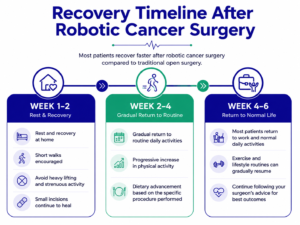
It is important to note that recovery varies depending on the type of cancer surgery performed and the patient’s overall health.
Why Trust Dr. Deep Goel for Robotic Cancer Surgery in Delhi?
Delhi has several hospitals with robotic systems. What you’re actually choosing is the surgeon’s experience, judgment, and volume of cases, not just the machine.
- Experience – Dr. Deep Goel is Vice Chairman and Head of Department, Surgical Gastroenterology, GI Cancer, Bariatric and Minimally Invasive Surgery at BLK-Max Super Speciality Hospital. With 27+ years in the field and 10,000+ surgeries, he is one of the most experienced GI cancer surgeons in Delhi.
- Advanced robotic technology – BLK-Max operates the Da Vinci Xi robotic system for advanced robotic surgery across GI, thoracic, and urological oncology. The hospital holds JCI and NABH accreditation. It is one of a small number of centres in India with a fully dedicated robotic cancer treatment programme across multiple cancer types.
- Cost advantage – Robotic cancer surgery in Delhi costs a fraction of what the same procedure costs abroad. Comparable surgery in the US runs to approximately $40,000. In Delhi, advanced cancer surgery of comparable quality is available at lower cost, which is why BLK-Max is a preferred destination for patients from across India and abroad.
- A practice built around GI cancer – Dr. Goel’s entire clinical focus is gastrointestinal cancers. Every case is evaluated with the full depth of a dedicated GI cancer surgery programme.
Key Takeaways
At BLK-Max, cancer surgery specialist Dr. Deep Goel combines the precision of advanced robotic surgery with 27 years of surgical judgment. Every plan is built around your specific tumour, your health, and your recovery.
If surgery has been recommended for a gastrointestinal cancer, don’t wait. A consultation will give you a clear picture of whether minimally invasive cancer surgery is the right path for your case, and exactly what to expect if it is.
You can book your consultation with Dr. Deep Goel today.
Frequently Asked Questions
Is robotic cancer surgery safe? expand_more
Yes. In the hands of an experienced robotic cancer surgeon, robotic oncology surgery is considered a safe. Patients seeking treatment from the best robotic cancer surgeon in Delhi should focus on factors such as surgical experience, cancer-specific expertise, case volume, and access to advanced robotic technology, all of which play an important role in achieving optimal outcomes.
What are the benefits of robotic cancer surgery? expand_more
The key benefits of robotic cancer surgery include less post-operative pain, reduced blood loss, shorter hospital stay (2-4 days compared to 5-10 days for open surgery), faster recovery, lower infection risk, and earlier ability to begin chemotherapy or radiation if needed.
What cancers can be treated with robotic surgery? expand_more
Robotic GI cancer surgery covers colon cancer, rectal cancer, stomach cancer, liver cancer, pancreatic cancer, esophageal cancer, and gallbladder cancer.
Who is the best robotic cancer surgeon in Delhi? expand_more
The choice of the best robotic cancer surgeon in Delhi depends on factors such as experience, surgical expertise, treatment outcomes, and specialisation in cancer care. Dr. Deep Goel, Vice Chairman and HOD of Surgical Gastroenterology and GI Cancer at BLK-Max Super Speciality Hospital, is among the leading robotic GI cancer surgeons in Delhi, with over 27 years of experience, international training, and extensive expertise in robotic surgery for gastrointestinal cancers.
Is robotic surgery better than open surgery for GI cancer? expand_more
For appropriate cases, yes. Robotic surgical oncology delivers comparable cancer clearance to open surgery with better recovery outcomes.

Dr. Deep Goel’s Medical Content Team
Dr. Deep Goel’s medical content team specialises in creating accurate, clear, and patient-focused healthcare content. With strong clinical understanding and expertise in technical writing and SEO, the team translates complex medical information into reliable, accessible resources that support informed decisions and uphold Dr. Goel’s commitment to quality care.
This content is reviewed by Dr. Deep Goel

Related Blogs
लिवर कैंसर के लक्षण, कारण और इलाज | Liver Cancer in Hindi
लिवर हमारे शरीर का एक बेहद ज़रूरी अंग है – यह खून साफ करता है,…
Read Article →
What is the Success Rate of Minimally Invasive Surgery in Treating Pancreatic Cancer?
Globally, pancreatic cancer presents a formidable challenge, with a substantial number of diagnoses annually. However,…
Read Article → WhatsApp