
Why Are Young Indians Getting Colon Cancer?

If you are in your 20s, 30s, or early 40s, you probably think colon cancer is something that happens in old age. Many of us do, but doctors across India are now seeing something that should make us stop and pay attention: colon cancer in young adults is rising, and rising fast.
Reach Out for Expert Care
First, What Exactly is Colon Cancer?
The colon is your large intestine, the final stretch of your digestive system. Its role is to absorb water and salts from digested food before waste leaves the body.
Colon cancer happens when cells inside the colon start dividing abnormally. It usually starts as a small, harmless growth called a polyp. Over time, some polyps can turn cancerous. This process takes years, which is exactly why early detection is so important.
For a detailed look at how colon cancer develops and how it is treated, visit our page on colon cancer treatment in India.
Is Colon Cancer Really Increasing in Young Indians?
Yes, and the numbers are hard to ignore.
Globally, colon cancer rates in adults are rising by about 3% every year. In India, studies show that rates in younger populations have nearly doubled since the early 1990s. The disease is now one of the leading causes of cancer-related deaths in adults between ages 20 and 49.
Until recently, colon cancer screening was recommended only after age 50. That guidance is now being reconsidered.
Why Are Young Adults Getting Colon Cancer in India?
The reason is a mix of lifestyle changes, diet shifts, and in some cases, genetics.
- The way we eat has changed – The consumption of more processed foods, packaged snacks, red meat, sugary drinks, and fried foods, and far less of the fibre-rich dals, vegetables, and whole grains that were once the backbone of the Indian diet.
- Sitting too much, moving too little – Desk jobs, long commutes, and hours of screen time mean that many young Indians today are far less active physically.
- Obesity is on the rise – Excess body weight, especially around the abdomen, creates chronic low-level inflammation in the body. This kind of long-term inflammation can increase cancer risk.
- Genetics and family history – People with Lynch syndrome have a much higher lifetime risk of developing colon cancer, sometimes before age 40.
- Stress and irregular routines – Chronic stress, disrupted sleep, and erratic eating patterns affect gut health in ways that are still being studied. Stress alone does not cause cancer, but it contributes to an environment where other risk factors are amplified.
For a stage-by-stage breakdown of what symptoms to watch for in colon cancer, read our blog on colon cancer symptoms.
Who is at Higher Risk?
Some people have a higher chance of developing colon cancer at a younger age. You fall into a higher-risk group if you have one or more of the following:
- A parent, sibling, or child who has had colon or colorectal cancer
- A personal history of polyps (growths inside the colon)
- A long-term gut condition such as Crohn’s disease or ulcerative colitis
- Lynch syndrome or familial adenomatous polyposis (FAP), inherited conditions that raise colon cancer risk
- Type 2 diabetes
- Heavy alcohol use or tobacco use
- Obesity
If several of these apply to you, speak to a doctor about when to start screening, even if you currently have no symptoms.
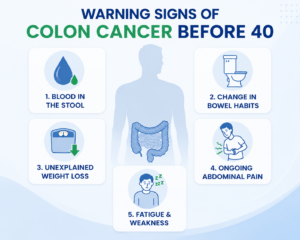
Warning Signs of Colon Cancer Before 40
Colon cancer in young adults can sometimes be mistaken for common digestive problems. If any of the following symptoms persist for more than 2-3 weeks, seek medical advice.
- Blood in the Stool – Bright red or dark blood in the stool should never be ignored.
- Persistent Change in Bowel Habits – Ongoing diarrhea, constipation, or narrower stools may need evaluation.
- Unexplained Weight Loss – Losing weight without trying can be a warning sign of an underlying condition.
- Ongoing Abdominal Pain – Persistent cramps, bloating, or discomfort deserve medical attention.
- Fatigue and Weakness – Unusual tiredness may result from hidden blood loss and anemia.
What Can You Do to Lower Your Risk of Colon Cancer?
There are things within your control that genuinely make a difference
- Eat more fibre – Include more vegetables, fruits, whole grains, and dals in your daily meals.
- Cut back on processed meat – You do not have to give up meat entirely. Just reduce how often you eat processed meats like sausages, salami, and packaged cold cuts.
- Move your body – Thirty minutes of moderate activity most days, walking, cycling, or yoga, is enough to make a meaningful difference.
- Maintain a healthy weight – Even modest weight loss if you are overweight can reduce your cancer risk.
- Do not ignore symptoms – If something feels off in your gut, take it seriously.
When Should You Get Screened for Colon Cancer?
For people with no symptoms and average risk, current guidelines recommend starting colon cancer screening around age 45 to 50. If you have a family history or any of the risk factors listed above, your doctor may suggest starting earlier.
The most common screening test is a colonoscopy
A stool test, which looks for hidden blood in the stool, is another option that is simpler to do and can be a good first step.
Good News: When Caught Early, Colon Cancer is Highly Treatable
When colon cancer is diagnosed at Stage 1 or Stage 2, outcomes are excellent. Surgery today is often performed using minimally invasive techniques, which means smaller incisions, less pain, and faster recovery.
The message is not to be afraid. The message is to be informed and to act early if something does not feel right.
Learn about Colon Cancer Treatment
Final Thoughts
Colon cancer is changing, and our awareness needs to change with it. Being young does not mean being immune. Understanding colon cancer, the warning signs, knowing your risk factors, and acting early when symptoms appear are among the most important steps you can take to protect your long-term health.

 WhatsApp