
Hernia Surgery Recovery Timeline: What to Expect, Week by Week

Google says two weeks. Your neighbor says four. Your body might say something else entirely.
This guide gives you that straight answer. We’ll walk through hernia surgery recovery day by day, then week by week. You’ll also get tables for quick reference, so you don’t have to re-read paragraphs mid-recovery.
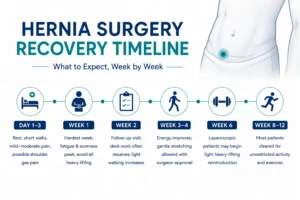
A quick note before we start: recovery speed depends on your hernia type, your repair method, and your overall health. Use this as a general roadmap. Always follow your own surgeon’s specific instructions.
Reach Out for Expert Care
What Happens Right After Surgery (Day 1-3)
Most hernia repairs are day-care procedures. That means you go home the same day, or after one night of observation.
Here’s what the first 72 hours usually look like:
- Grogginess from anesthesia. This fades within a few hours.
- Mild to moderate pain at the incision site, managed with medication.
- Swelling and bruising. This is a normal healing response, not a red flag.
- Short walks, encouraged early to keep blood flowing and prevent clots.
- Shoulder pain, if you had laparoscopic (keyhole) surgery. This comes from leftover carbon dioxide gas used to inflate the abdomen during surgery. It usually settles within a day or two.
Laparoscopic surgery means the surgeon operates through a few small cuts using a camera and thin instruments, instead of one large incision. It generally causes less pain and a faster early recovery than open surgery.
Click here to read more about hernia treatment
Week 1: The Hardest Week
Research from Mayo Clinic found something patients don’t expect. Fatigue and pain often don’t return to normal until around day seven, even after minimally invasive repair.
So if week one feels harder than you imagined, that’s common. It doesn’t mean something is wrong.
During week one, focus on:
- Resting more than you think you need to
- Keeping the incision clean and dry
- Avoiding lifting anything heavier than a light grocery bag
- Watching for warning signs (see table below)
- Taking pain medication as prescribed, not just when pain becomes severe
Most patients also see their surgeon for a follow-up check around the two-week mark, to confirm healing is on track.
Week 2 to 4: Regaining Energy
By week two, most people feel noticeably better. Energy returns. Swelling reduces. Walking distances increase.
This is also when many patients return to desk-based work. But physical jobs need more time.
Heavy lifting is still restricted in this window. Tissue and mesh (a surgical mesh, used to reinforce the weakened muscle wall) need time to integrate properly. Rushing this step raises the risk of hernia recurrence.
Month 1 to 3: Full Activity Return
Somewhere between six and twelve weeks, most patients get cleared for unrestricted activity. This includes gym workouts, running, and manual labor.
This clearance isn’t automatic. It depends on your surgeon confirming the repair has fully healed.
The first three months carry the highest recurrence risk if activity restrictions are ignored. Patience here protects your long-term result.
Recovery Timeline at a Glance
| Timeframe | What to Expect |
| Day 1-3 | Rest, short walks, mild-moderate pain, possible shoulder gas pain |
| Week 1 | Hardest week; fatigue and soreness peak; avoid all heavy lifting |
| Week 2 | Follow-up visit; desk work often resumes; light walking increases |
| Week 3-4 | Energy improves; gentle stretching allowed with surgeon approval |
| Week 6 | Laparoscopic patients may begin light heavy-lifting reintroduction |
| Week 8-12 | Most patients cleared for unrestricted activity and exercise |
Activity Restrictions: Laparoscopic vs. Open Surgery
| Activity | Laparoscopic Repair | Open Repair |
| Desk work return | 3–5 days | About 1 week |
| Driving | Once off pain medication, usually ~1-2 weeks | Same, usually ~1-2 weeks |
| Light walking | Day 1, encouraged | Day 1, encouraged |
| Heavy lifting (20+ lbs) | Around 2 weeks | 4-6 weeks |
| Full exercise/sports | 6-8 weeks, with clearance | 8-12 weeks, with clearance |
These are general ranges from surgical literature. Your surgeon may adjust based on your specific case.
Pain Expectations Timeline
| Period | Typical Pain Level | Management |
| Day 1-3 | Moderate | Prescribed pain medication |
| Day 4-7 | Mild to moderate | Over-the-counter medication often sufficient |
| Week 2 | Mild | Discomfort with movement, not at rest |
| Week 3-4 | Minimal | Occasional twinges, especially with strain |
| Month 2+ | Rare | Should be near pain-free; report ongoing pain |
Work Return Timeline
| Job Type | Laparoscopic Repair | Open Repair |
| Desk/remote work | 3-5 days | 5-7 days |
| Light physical work | 1-2 weeks | 2-3 weeks |
| Moderate lifting jobs | 3-4 weeks | 4-6 weeks |
| Heavy manual labor | 6-8 weeks | 6-12 weeks |
Diet Guide After Hernia Surgery
Your gut needs gentle handling in the first few days, especially if anesthesia has slowed digestion.
| Stage | What to Eat |
| Day 1 | Clear fluids, soups, coconut water |
| Day 2–3 | Soft foods: khichdi, dal, curd, bananas |
| Week 1 | Add fiber gradually to prevent constipation |
| Week 2 onward | Return to a normal, balanced diet |
A few general tips:
- Avoid carbonated drinks. They can cause bloating.
- Add fiber slowly. Sudden fiber spikes can cause gas and discomfort.
- Stay hydrated. This supports digestion and healing.
- Avoid alcohol until your surgeon confirms it’s safe.
Warning Signs: When to Call Your Doctor
Contact your surgical team right away if you notice any of the following:
- Fever above 100.4°F (38°C). May signal infection.
- Increasing redness or discharge at the incision site.
- Severe or worsening pain that medication doesn’t control.
- New swelling or a bulge returning at the surgery site.
- Vomiting or inability to pass gas. Could indicate a complication.
When in doubt, call. It’s always better to check early.
What Affects Your Personal Timeline
No two recoveries look identical. These factors matter most:
- Hernia type. Inguinal (groin), umbilical (belly button), or incisional hernias each heal differently.
- Surgical approach. Laparoscopic and robotic repairs typically heal faster than open surgery.
- Hernia size and complexity. Larger or recurrent hernias need more healing time.
- Age and overall health. Conditions like diabetes can slow healing.
- How closely you follow post-op instructions. This is the single biggest factor within your control.
For a deeper look at how hernias develop and their warning signs, read our guide on early hernia symptoms.
Final Thoughts
Hernia surgery recovery isn’t a race. It’s a phased process, with each week building on the last.
Following your personalized timeline protects both your comfort and your results. If you’re unsure whether your recovery is on track, don’t guess.
For personalized guidance on your hernia type and treatment options, explore our complete hernia treatment guide, or you can book a consultation with Dr. Deep Goel’s team at BLK-Max Super Speciality Hospital.

 WhatsApp