
HIPEC surgery in India
HIPEC surgery in India combines cytoreductive surgery (removing visible tumours from the abdomen) with a heated chemotherapy wash. It’s used for cancers that have spread only to the abdominal lining, including appendix cancer, peritoneal mesothelioma, and select colorectal or ovarian cases. Candidacy depends on a score called the PCI. Not every patient qualifies, and a proper evaluation is the only way to know.
Reach Out for Expert Care
HIPEC Surgery in India: A Treatment Option for Advanced Abdominal Cancer
Hearing that cancer has spread to the lining of your abdomen, the peritoneum, feels like a door closing. Most patients assume it means chemotherapy alone, with surgery off the table.
For a specific group of patients, that assumption is wrong. HIPEC surgery in India has given a real shot at long-term survival to people who were told they had no surgical options left.
At BLK-Max Super Speciality Hospital, GI cancer surgeon Dr. Deep Goel evaluates patients with peritoneal spread to see whether cytoreductive surgery with HIPEC is appropriate. With over 27 years of experience and 10,000+ surgeries performed, he brings a GI oncology focus to a procedure that demands exactly that kind of specialised judgement. This page walks through what HIPEC actually involves, who qualifies, and what to expect.
What Is HIPEC Surgery?
(Hyperthermic Intraperitoneal Chemotherapy)
HIPEC (Hyperthermic Intraperitoneal Chemotherapy) is a heated chemotherapy treatment delivered directly into the abdominal cavity immediately after cytoreductive surgery (CRS) removes all visible tumours. It targets microscopic cancer cells that surgery cannot remove and is not used as a standalone treatment.
During the procedure, the chemotherapy solution is heated to 42-43°C and circulated throughout the abdomen for 60–90 minutes. Because it is delivered directly to the affected area rather than through the bloodstream, HIPEC allows higher local drug concentrations while reducing many of the systemic side effects associated with conventional chemotherapy.
What Is Cytoreductive Surgery (CRS) and Why Is It Performed Before HIPEC?
Cytoreductive surgery (CRS) is the first and most important step of HIPEC treatment. During this procedure, the surgeon removes all visible tumours from the abdominal cavity, which may include parts of the bowel, spleen, gallbladder, or the lining of the abdomen if affected.
CRS is essential because HIPEC can only destroy microscopic cancer cells. Heated chemotherapy penetrates only a few millimetres into tissue, so any visible tumour left behind cannot be effectively treated. Once all visible disease has been removed, the heated chemotherapy is circulated throughout the abdomen to target any remaining microscopic cancer cells.
Which Cancers Can Be Treated with HIPEC Surgery?
HIPEC surgery in India is reserved for cancers that have spread to the peritoneum but haven’t reached to distant organs through the blood or lymph system. The main groups are:
- Appendix cancer and pseudomyxoma peritonei (PMP): This is the strongest evidence base for HIPEC. CRS-HIPEC is recognised by the Peritoneal Surface Oncology Group International as the first-line treatment for PMP arising from the appendix.
- Peritoneal mesothelioma: A rare cancer originating in the abdominal lining itself.
- Colorectal cancer with peritoneal spread: Used when the disease is confined to the abdomen rather than the liver or lungs.
- Ovarian cancer: Particularly when the spread is limited to the peritoneal surface.
- Select gastric cancers: Used cautiously, in carefully chosen cases with limited peritoneal involvement.
For colorectal cancer and stomach cancer patients specifically, peritoneal spread is one of the more common ways these cancers progress, which is why evaluation for HIPEC often comes up during treatment planning for these conditions.
Who Is Eligible for HIPEC Surgery in India?
Eligibility for HIPEC surgery depends on whether the cancer is confined to the peritoneum and can be completely removed. Surgeons assess this using the Peritoneal Cancer Index (PCI), a score based on the size and extent of cancer within the abdomen. Lower PCI scores generally indicate a better chance of successful treatment.
Patients with cancer that has spread to the liver, lungs, or distant lymph nodes, or those with serious heart, lung, or kidney conditions, are usually not suitable candidates for CRS and HIPEC. Final eligibility is determined after evaluating the PCI score, overall health, and previous treatments.
How Is HIPEC Surgery Performed? Step-by-Step Procedure
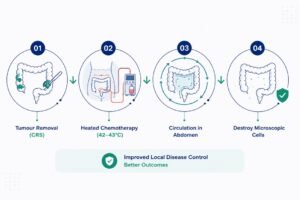
A typical HIPEC surgery in India follows this sequence:
- Pre-operative workup: CT or MRI imaging to estimate the PCI score, blood tests, and a fitness assessment.
- Cytoreductive surgery: The surgeon removes all visible tumour and affected tissue. This stage alone can take several hours.
- Heated chemotherapy wash: Once cytoreduction is complete, the heated solution is circulated through the abdomen for about an hour.
- Drainage and closure: The solution is drained, the abdomen is rinsed, and the incision is closed.
| Stage | Typical Duration |
|---|---|
| Cytoreductive surgery | 4-10 hours |
| HIPEC chemotherapy wash | 60-90 minutes |
| Total operating time | 6-14 hours |
The wide range reflects how different each case is. A patient with a low PCI score and disease in one or two regions takes far less time than someone with extensive, multi-region spread.
Reach Out for Expert Care
Recovery After HIPEC Surgery
Recovery after HIPEC surgery in India is longer than after most cancer operations, because the procedure itself is more extensive. Most patients spend the first few days in the ICU for close monitoring, since the body needs time to recover from both the surgery and the chemotherapy load.
| Phase | Typical Timeline |
|---|---|
| ICU stay | 2-5 days |
| Total hospital stay | 7-14 days |
| Return to light activity | 4-6 weeks |
| Full recovery | 2-3 months |
Early mobilisation, nutritional support, and pain management all play a role in how smoothly recovery goes. Patients are encouraged to start moving as soon as it’s safe, even while still in the hospital.
What Are the Risks and Complications of HIPEC Surgery?
HIPEC is a major surgery and, like any complex cancer procedure, carries risks such as bleeding, infection, bowel leaks, and intra-abdominal abscesses. The likelihood of complications depends on the extent of surgery and the patient’s overall health.
As CRS-HIPEC is a highly specialised procedure, it should be performed by an experienced GI cancer surgeon at a centre with dedicated surgical teams, ICU support, and a multidisciplinary cancer team to help ensure the safest possible outcomes.
HIPEC Surgery Cost in India (2026)
HIPEC surgery cost in India typically ranges from ₹3,00,000 to ₹6,00,000 for standard cases. However, the total cost may increase to ₹12,00,000 for complex cases requiring extensive surgery, longer ICU care, or additional procedures.
Factors that influence the cost include:
- PCI score and extent of disease
- Length of ICU and hospital stay
- Chemotherapy drugs used
- Additional procedures, such as bowel resection or organ reconstruction
As every patient’s condition is different, the final cost is determined after evaluating imaging, blood tests, and the overall treatment plan. A consultation provides the most accurate estimate for your case.
You can read more about related GI cancer surgery cost in Delhi for additional context on how these estimates are built.
Why Trust Dr. Deep Goel for HIPEC Surgery in India?
Dr. Deep Goel is Vice Chairman and Head of Department, Surgical Gastroenterology, GI Cancer, Bariatric and Minimally Invasive Surgery at BLK-Max Super Speciality Hospital, Delhi. His clinical focus on gastrointestinal cancers means HIPEC candidacy is assessed within the full context of a dedicated GI cancer surgery programme, rather than as an isolated procedure.
BLK-Max is a JCI and NABH accredited hospital with the ICU infrastructure that a procedure like this requires. For patients travelling from across India or abroad, that combination of surgical experience and hospital-level support is what actually determines outcomes, not just access to the equipment.
Key Takeaways
HIPEC surgery in India isn’t right for every patient with peritoneal spread, but for the right candidate, it offers something systemic chemotherapy alone can’t: a real chance at long-term disease control. The only way to know where you stand is a proper evaluation of your scans, your PCI score, and your overall health.
Book your consultation with Dr. Deep Goel to find out if HIPEC is the right path for your case.
Frequently Asked Questions
How long does it take to recover from HIPEC surgery? expand_more
Recovery after HIPEC surgery usually requires 7–14 days of hospitalisation, followed by 4-6 weeks before returning to light activities. Most patients recover fully within 2-3 months, depending on the extent of surgery and their overall health.
Who is eligible for HIPEC surgery in India? expand_more
Patients whose cancer is limited to the peritoneum and can be completely removed may be eligible for HIPEC surgery in India. Eligibility is assessed using imaging, the Peritoneal Cancer Index (PCI), and the patient's overall health.
Which cancers can be treated with HIPEC surgery? expand_more
HIPEC surgery is commonly used for appendix cancer, colorectal cancer, ovarian cancer, peritoneal mesothelioma, and selected cases of stomach cancer when the disease is confined to the abdominal lining.
Is HIPEC surgery better than chemotherapy alone? expand_more
HIPEC surgery combines tumour removal with heated chemotherapy delivered directly into the abdomen. For carefully selected patients with peritoneal cancer, it may offer better local disease control than systemic chemotherapy alone.

Dr. Deep Goel’s Medical Content Team
Dr. Deep Goel’s medical content team specialises in creating accurate, clear, and patient-focused healthcare content. With strong clinical understanding and expertise in technical writing and SEO, the team translates complex medical information into reliable, accessible resources that support informed decisions and uphold Dr. Goel’s commitment to quality care.
This content is reviewed by Dr. Deep Goel
Related Treatments

GI Cancer Surgery in Delhi
Gastrointestinal (GI) cancers affect the organs of the digestive system, including the oesophagus, stomach, liver, pancreas, gallbladder, bile ducts, small…
Robotic Gastrointestinal (GI) Surgery in Delhi
Robotic gastrointestinal (GI) surgery is an advanced robot-assisted, minimally invasive surgical technique used to treat selected digestive disorders and gastrointestinal…
Related Blogs

पेट के कैंसर के शुरुआती लक्षण: कैसे पहचानें?
पेट का कैंसर (Stomach Cancer) पेट की अंदरूनी परत में बनने वाला कैंसर है। शुरुआती…
Read Article →
Gallstone Symptoms: What the Pain Is Really Telling You
Most people who have gallstones have been misdiagnosed at least once not by a doctor,…
Read Article → WhatsApp