
Robotic Gastrointestinal (GI) Surgery in Delhi
Robotic gastrointestinal (GI) surgery is an advanced robot-assisted, minimally invasive surgical technique used to treat selected digestive disorders and gastrointestinal cancers. Unlike conventional open surgery, it enables surgeons to perform complex procedures through small incisions using a surgeon-controlled robotic system that provides high-definition 3D visualisation, enhanced precision, and greater instrument dexterity.
At BLK-Max Super Speciality Hospital, Delhi, Dr. Deep Goel, a senior GI and HPB surgeon with over 27 years of experience, performs robotic gastrointestinal surgery for a wide range of benign and cancerous conditions affecting the digestive tract. Every procedure is planned after a comprehensive evaluation to determine whether a robotic, laparoscopic, or open surgical approach is most appropriate for the patient’s condition.
If you or a loved one has been advised to undergo gastrointestinal surgery, understanding how robotic surgery works, when it is recommended, its potential benefits, and whether it is the right option for your condition can help you make a well-informed treatment decision. This guide covers everything you need to know about robotic gastrointestinal (GI) surgery, from conditions treated and recovery to expected outcomes and frequently asked patient questions.
Reach Out for Expert Care
Robotic GI Surgery in Delhi: Key Facts
| Feature | Details | |
| 1 | Procedure Type | Robot-assisted minimally invasive gastrointestinal surgery |
| 2 | Technology Used | Surgeon-controlled robotic surgical system with high-definition 3D visualisation and wristed instruments |
| 3 | Conditions Treated | Selected gastrointestinal cancers , hernia, gallbladder disease, liver and pancreatic conditions, GERD, hiatal hernia, and other digestive disorders |
| 4 | Hospital Stay | 2-5 days (exact stay depends on disease type) |
| 5 | Surgery Duration | 1-6 hours |
| 6 | Benefits | Smaller incisions, less pain, higher precision, lower complication risk |
What Is Robotic GI Surgery?
Robotic gastrointestinal (GI) surgery is an advanced robot-assisted, minimally invasive surgical technique used to treat selected conditions affecting the digestive tract. During the procedure, the surgeon controls robotic instruments from a specialised console, translating every hand movement into highly precise, real-time movements inside the patient’s body.
The robotic platform provides a high-definition, three-dimensional view of the surgical field along with wristed instruments that offer a greater range of motion than the human hand. This enhanced visualisation allow surgeons to operate with precision, particularly in deep areas of the abdomen where conventional techniques may be more challenging.
Compared with traditional open surgery, and in selected cases even conventional laparoscopic surgery, robotic GI surgery can facilitate complex procedures through smaller incisions while reducing trauma to surrounding tissues. For appropriately selected patients, this may contribute to less post-operative pain, reduced blood loss, a lower risk of wound-related complications, and a faster recovery.
However, the most appropriate surgical approach robotic, laparoscopic, or open is determined based on the patient’s condition, disease complexity, and overall health.
Conditions Treated with Robotic GI Surgery
Robotic gastrointestinal surgery is used to treat a wide range of benign digestive disorders and gastrointestinal cancers.
Common conditions that may be treated using robotic GI surgery include:
Colorectal Cancer
Robotic surgery may be recommended for selected colon and rectal cancers, particularly when operating within the narrow confines of the pelvis where enhanced visualisation and instrument dexterity can support precise tumour removal.
Stomach (Gastric) Cancer
For appropriately selected patients, robotic gastrectomy enables removal of part or all of the stomach through a minimally invasive approach while supporting precise lymph node dissection.
Gallbladder Disease and Gallbladder Cancer
Robotic surgery may be used to treat complex gallbladder conditions, including gallstones, chronic inflammation, and selected cases of gallbladder cancer requiring removal of surrounding tissue.
Hernia
Robotic-assisted hernia repair may be considered for large, recurrent, bilateral, or complex abdominal wall hernias, where improved instrument control can facilitate accurate reconstruction.
Liver and Pancreatic Conditions
Selected liver tumours, pancreatic tumours, and other hepatopancreatobiliary (HPB) conditions may be managed using robotic techniques when a minimally invasive approach is clinically appropriate.
GERD and Hiatal Hernia
Robotic surgery may be recommended for patients with gastroesophageal reflux disease (GERD) or hiatal hernia who do not respond adequately to medications, helping restore normal anatomy and reduce reflux symptoms.
Oesophageal Conditions
Certain benign and cancerous conditions affecting the oesophagus (food pipe), including oesophageal cancer, may be treated using robotic-assisted surgery in carefully selected patients.
The suitability of robotic surgery depends on factors such as the type of condition, disease stage, tumour location, previous abdominal surgery, and overall health. Following a comprehensive evaluation, your surgeon will determine whether a robotic, laparoscopic, or open surgical approach is the safest and most effective option.
One of the main reasons robotic gastrointestinal surgery in Delhi is gaining acceptance is its flexibility. It is used to treat a wide range of GI conditions, both cancerous and non-cancerous.
Who May Be a Candidate for Robotic GI Surgery?
Not every patient requiring gastrointestinal surgery is a suitable candidate for a robotic-assisted procedure. The choice of surgical approach depends on the condition being treated, disease stage, anatomical complexity, previous surgical history, and the patient’s overall health.
Robotic GI surgery may be considered for patients who:
- Have selected gastrointestinal cancers, including colorectal, stomach, oesophageal, liver, or pancreatic cancers that are suitable for a minimally invasive approach.
- Require surgery in deep or anatomically confined areas, such as the pelvis, where enhanced visualisation and instrument dexterity may be beneficial.
- Have complex, recurrent, or bilateral hernias that require precise abdominal wall reconstruction.
- Have undergone previous abdominal surgery, where scar tissue (adhesions) can make conventional surgery more technically challenging.
- May benefit from a minimally invasive approach due to factors such as age, obesity, or other medical conditions, when clinically appropriate.
- Are expected to benefit from smaller incisions, reduced post-operative pain, and a faster recovery, based on their individual surgical needs.
A comprehensive consultation, including clinical examination, imaging studies, and review of medical history, helps determine whether robotic, laparoscopic, or open surgery is the safest and most effective treatment option for each patient.
Is Robotic GI Surgery the Best Option for Every Patient?
Robotic gastrointestinal (GI) surgery offers several advantages for selected patients, but it is not the most appropriate approach in every situation. The choice of surgical technique depends on factors such as the condition being treated, disease stage, tumour size and location (for cancer), previous abdominal surgeries, overall health, and the complexity of the procedure.
For many patients with benign digestive disorders or gastrointestinal cancers, robotic surgery can provide excellent precision through a minimally invasive approach. However, very large tumours, involving nearby organs or emergency conditions may be better managed with laparoscopic or open surgery.
Rather than recommending one technique for every patient, Dr. Deep Goel carefully evaluates each case using clinical examination, imaging studies, and other investigations to determine the safest and most effective surgical approach. The primary goal is always complete disease treatment while prioritising patient safety.
Benefits of Robotic GI Surgery
For appropriately selected patients, robotic gastrointestinal surgery combines the advantages of a minimally invasive approach with advanced surgical technology. The enhanced precision, high-definition three-dimensional visualisation, and greater instrument dexterity offered by the robotic platform can help surgeons perform complex procedures while minimising trauma to surrounding tissues.
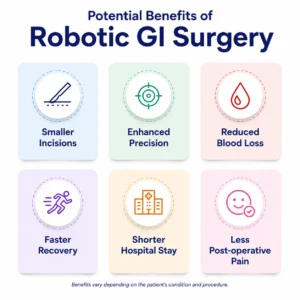
Smaller Incisions
Most robotic procedures are performed through several small incisions, typically measuring 0.5–1 cm, which may reduce scarring compared with traditional open surgery.
Less Post-operative Pain
Because the procedure involves less disruption of muscles and surrounding tissues, many patients experience less discomfort during recovery.
Reduced Blood Loss
Enhanced precision and improved control of surgical instruments may help minimise tissue trauma and reduce blood loss during surgery.
Lower Risk of Wound-related Complications
Smaller incisions are generally associated with a lower risk of wound infection and other incision-related complications.
Shorter Hospital Stay
Depending on the procedure and individual recovery, many patients are discharged within 2–5 days after surgery.
Faster Recovery and Return to Daily Activities
Most patients are able to resume light daily activities within 2–3 weeks, although complete recovery varies according to the type and complexity of surgery.
Enhanced Precision for Complex Procedures
The robotic system’s high-definition 3D visualisation and wristed instruments provide greater dexterity in confined anatomical spaces, which can be particularly beneficial during complex gastrointestinal, colorectal, liver, and pancreatic procedures.
While these advantages are well recognised, outcomes also depend on factors such as the underlying condition, disease stage, surgical complexity, and the experience of the operating surgeon.
For patients dealing with a serious GI condition, these advantages are not small. They affect quality of life during recovery, time away from family and work, and in some cases, long-term surgical outcomes.
Reach Out for Expert Care
How Robotic GI Surgery Is Performed in Delhi
Robotic gastrointestinal surgery follows a carefully planned process designed to maximise surgical precision, patient safety, and recovery. While the exact steps vary depending on the procedure being performed, most robotic GI operations follow the sequence below.
Before Surgery
- Comprehensive consultation, physical examination, and review of medical history
- Blood tests, imaging studies, and other investigations to assess the condition and plan the procedure
- Discussion of the recommended surgical approach, expected benefits, potential risks, and recovery timeline
- Pre-anaesthetic evaluation and hospital admission on the day of surgery or as advised
During Surgery
- The procedure is performed under general anaesthesia.
- Several small incisions (ports) are created to allow insertion of a high-definition 3D camera and specialised robotic instruments.
- The surgeon operates from a dedicated robotic console, where every hand movement is translated into precise movements of the robotic instruments.
- Throughout the procedure, the surgical team continuously monitors the patient’s condition to ensure safety.
- Depending on the type and complexity of surgery, the procedure may take approximately 1–6 hours.
After Surgery
- Patients are closely monitored in the recovery room before being transferred to the ward.
- Pain is managed using appropriate medications, and early mobilisation is encouraged whenever possible.
- Depending on the procedure, patients gradually resume oral intake under medical supervision.
- Before discharge, patients receive guidance on wound care, medications, dietary progression, physical activity, and follow-up appointments to support a smooth recovery.
Every robotic GI procedure is planned according to the patient’s diagnosis, overall health, and surgical complexity to ensure the most appropriate treatment approach.
Recovery After Robotic GI Surgery
Recovery duration usually depends on the complexity of the procedure, but robotic surgery typically offers faster healing than open surgery.
- Hospital stay: 2-5 days for most procedures
- Return to light activities: 2-3 weeks
- Return to work: 3-4 weeks
- Full recovery: 4-8 weeks, depending on the procedure
Patients go home with written instructions on wound care, dietary progression, activity restrictions, and follow-up appointments. Nutritional guidance is particularly important after stomach or intestinal surgery, and a dietitian is involved in care where needed.
Cost of Robotic GI Surgery in Delhi
The cost of robotic GI surgery in Delhi varies by procedure, hospital, complexity, and individual patient factors. As a general guide:
| Procedure | Estimated Average Cost Range |
| Robotic Hernia Repair | ₹1.5 – ₹3.5 Lakh |
| Robotic Cholecystectomy | ₹1.5 – ₹3 Lakh |
| Robotic Colorectal Surgery | ₹3 – ₹6 Lakh |
| Robotic Gastrectomy (Stomach) | ₹3.5 – ₹6 Lakh |
| Robotic Liver Resection | ₹4 – ₹8 Lakh |
| Robotic Whipple Procedure | ₹5 – ₹10 Lakh |
| Robotic Anti-Reflux Surgery | ₹2 – ₹4 Lakh |
Factors that determine the final cost include the type and complexity of treatment, the duration of the hospital stay, and, if required, postoperative oncology care.
Why Choose Dr. Deep Goel for Robotic GI Surgery in Delhi?
When looking for the best robotic GI surgeon in Delhi, experience and specialised expertise are crucial for the best outcomes.
With over 27 years of experience in gastrointestinal (GI) and hepatopancreatobiliary (HPB) surgery, Dr. Deep Goel has extensive experience managing both routine and highly complex digestive disorders using open, laparoscopic, and robotic surgical techniques. Every treatment plan is individualised to ensure patients receive the most appropriate surgical approach for their condition.
- 27+ years of specialised experience in gastrointestinal and HPB surgery.
- 20,000+ GI surgical procedures performed across open, laparoscopic, and robotic platforms.
- Expertise in complex gastrointestinal procedures, including Whipple surgery, liver resection, colorectal surgery, oesophageal surgery, and advanced minimally invasive GI procedures.
- A multidisciplinary approach involving oncologists, radiologists, gastroenterologists, anaesthesiologists, pathologists, and dietitians to provide coordinated treatment planning.
- Focus on evidence-based, patient-centred care, with treatment decisions based on the patient’s diagnosis, overall health, and long-term recovery goals.
- Commitment to clear communication, ensuring patients understand their treatment options, expected outcomes, and recovery before surgery.
For patients considering robotic GI surgery in Delhi, Dr. Deep Goel combines extensive surgical experience with advanced robotic technology to deliver personalised care focused on safety, precision, and long-term outcomes.
Why International Patients Choose Delhi for Robotic GI Surgery
Delhi is one of India’s leading destinations for advanced gastrointestinal and robotic surgery, attracting patients from South Asia, the Middle East, Africa, Central Asia, and neighbouring countries. The city combines experienced surgical specialists, modern healthcare infrastructure, and internationally recognised hospitals, making it a preferred choice for patients seeking high-quality treatment.
International patients often choose Delhi because of:
- Access to advanced robotic surgical technology for complex gastrointestinal and hepatopancreatobiliary (HPB) procedures.
- Experienced GI and HPB surgeons with expertise in robotic, laparoscopic, and open surgery.
- Cost-effective treatment compared with many countries, while maintaining high standards of care.
- Timely access to specialist consultations and surgery, helping reduce delays in treatment.
- Multidisciplinary care, with coordinated support from surgeons, oncologists, radiologists, anaesthesiologists, and rehabilitation teams.
- Comprehensive international patient services, including medical visa assistance, airport transfers, interpreter support (where required), accommodation guidance, and follow-up care after discharge.
From the initial consultation through surgery, recovery, and post-operative follow-up, international patients receive coordinated support designed to make treatment and travel as smooth and comfortable as possible.
Take the First Step Towards Robotic GI Surgery in Delhi
If you have been diagnosed with a gastrointestinal cancer, hernia, gallbladder disease, GERD, or another digestive condition that may require surgery, an early consultation can help you understand the treatment options available and determine the most appropriate surgical approach.
Every patient is different. Factors such as your diagnosis, disease stage, overall health, and previous surgical history all influence whether robotic, laparoscopic, or open surgery is the safest and most effective option.
Consult Dr. Deep Goel for a comprehensive evaluation, personalised treatment recommendations, and expert guidance on whether robotic gastrointestinal surgery is the right choice for your condition.

Dr. Deep Goel’s Medical Content Team
Dr. Deep Goel’s medical content team specialises in creating accurate, clear, and patient-focused healthcare content. With strong clinical understanding and expertise in technical writing and SEO, the team translates complex medical information into reliable, accessible resources that support informed decisions and uphold Dr. Goel’s commitment to quality care.
This content is reviewed by Dr. Deep Goel
Related Treatments

GI Cancer Surgery in Delhi
Gastrointestinal (GI) cancers affect the organs of the digestive system, including the oesophagus, stomach, liver, pancreas, gallbladder, bile ducts, small…
HIPEC surgery in India
HIPEC surgery in India combines cytoreductive surgery (removing visible tumours from the abdomen) with a heated chemotherapy wash. It’s used…
Related Blogs

पेट के कैंसर के शुरुआती लक्षण: कैसे पहचानें?
पेट का कैंसर (Stomach Cancer) पेट की अंदरूनी परत में बनने वाला कैंसर है। शुरुआती…
Read Article →
Gallstone Symptoms: What the Pain Is Really Telling You
Most people who have gallstones have been misdiagnosed at least once not by a doctor,…
Read Article → WhatsApp