
Anal Cancer Treatment in India
Most people who receive an anal cancer diagnosis have spent weeks, sometimes months, being told it is probably piles. Anal Cancer is one of the most misdiagnosed cancers in India, not because the signs aren’t there, but because an anal symptom in India almost always gets labelled as piles and left at that.
Here is what that delay costs: anal cancer caught at Stage 1 has a survival rate of over 80%. The same cancer, found at Stage 4, is a very different situation.
Anal cancer is also one of the few GI cancers where surgery is not always the first answer. For most patients, a combination of chemotherapy and radiation can shrink or eliminate the tumour, preserving normal bowel function.
Dr. Deep Goel at BLK-Max Super Speciality Hospital, New Delhi, has performed over 10,000 GI surgeries across 27 years. His team sees patients from across India and from countries including Bangladesh, Nepal, Kenya, Iraq, and the UAE, many of whom arrive after months of misdiagnosis elsewhere.
If you or someone close to you has just been diagnosed, or is still trying to get a clear answer, this page covers what you actually need to know about anal cancer treatment.
What is Anal Cancer?
Anal cancer starts in the tissues of the anus, the opening at the lower end of the digestive tract. The most common type is squamous cell carcinoma, which develops from the cells lining the anal canal. While anal cancer is rare compared to other GI cancers, it is treatable when caught at the right stage.
Most anal cancers are closely linked to the human papillomavirus (HPV). In fact, nearly 90% of anal cancer cases show HPV involvement. Other types include adenocarcinoma, which develops from the mucus-producing cells of the anus, and perianal skin cancers, which form on the outer skin around the anus.
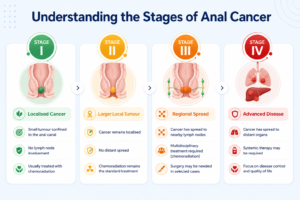
Understanding which type of anal cancer you have matters, because it directly affects which treatment works best for you.
What Are the Symptoms of Anal Cancer?
The most common symptoms of anal cancer include bleeding from the anus, pain or discomfort in the anal area, a lump or swelling near the anus, and changes in bowel habits. These symptoms are easy to dismiss as piles or a fissure, which is why so many patients come in at a later stage.
If you notice any of the following, do not wait:
- Bleeding during or after a bowel movement
- A lump, swelling, or ulcer around the anus
- Persistent itching, pain, or a burning sensation around the anus
- Mucus discharge from the anus
- A feeling that the bowel has not fully emptied
- Swollen lymph nodes in the groin
These symptoms can have other, non-cancerous causes, but only a doctor can confirm that. If symptoms have been present for more than two to three weeks, get checked.
Who is at Risk of Developing Anal Cancer?
Certain factors increase the likelihood of developing anal cancer. These include:
- HPV infection
- A weakened immune system, including patients living with HIV
- A history of other HPV-related cancers, such as cervical or vaginal cancer
- Anal intercourse
- Smoking, which raises risk in HPV-positive individuals
- Age above 50, though younger patients are increasingly being diagnosed
Getting vaccinated against HPV and attending regular screenings if you fall into a high-risk group is advised.
How is Anal Cancer Diagnosed?
Diagnosis usually begins with a physical examination, followed by one or more of these tests:
Digital anorectal examination (DARE): The doctor uses a gloved finger to feel for any lumps or abnormalities inside the anal canal.
Anoscopy or proctoscopy: A small lighted tube is used to look inside the anus and lower rectum. If anything suspicious is found, a tissue sample (biopsy) is taken for lab testing.
Imaging scans: Once anal cancer is confirmed, scans are used to determine how far it has spread. These typically include an MRI, a CT scan, and sometimes an endorectal ultrasound. Staging is critical because it decides the treatment approach.
What Are the Treatment Options for Anal Cancer in India?
-
Chemoradiation
For most anal cancer patients, the first treatment is chemoradiation, a combination of chemotherapy and radiation therapy given at the same time. This approach has a strong track record: many patients achieve complete remission without needing surgery at all.
Chemotherapy drugs are delivered to make cancer cells more sensitive to radiation. Radiation is delivered externally, five days a week, over five to six weeks. Modern radiation techniques such as intensity-modulated radiotherapy (IMRT) allow doctors to precisely target the tumour while protecting surrounding healthy tissue.
This treatment is recommended for most Stage 1 to Stage 3 anal cancers.
-
Surgery for anal cancer: When is it Needed?
Surgery is used in specific situations. For very small, early-stage tumours that have not spread to the muscles around the anus, a local resection may be possible. The tumour and a small margin of healthy tissue around it are removed, and the sphincter (the muscle that controls bowel movements) is preserved.
For larger tumours, or when the cancer has not responded fully to chemoradiation, or if it comes back after initial treatment, a more extensive operation called abdominoperineal resection (APR) may be required. Dr. Deep Goel performs abdominoperineal resection in Delhi with a focus on minimising complications.
APR involves the removal of the anus, rectum, and part of the colon. Patients who undergo this procedure will have a permanent colostomy, where the colon is connected to an opening in the abdomen for waste to pass out. The team at BLK-Max provides full stoma care support and counselling before and after surgery.
-
Palliative Care
For patients with advanced anal cancer where cure is not possible, palliative treatment aims to reduce pain, manage symptoms, and maintain quality of life. This may involve lower-dose chemotherapy, radiation, or targeted drug therapies.
What is the Survival Rate for Anal Cancer?
When caught early, the outlook for anal cancer is genuinely good. Patients with localised anal cancer (confined to the anus) have a five-year survival rate of around 81%. Even in cases where cancer has spread to nearby lymph nodes, many patients respond well to chemoradiation.
The key message here: the earlier you act on anal cancer symptoms, the better are your chances of a straightforward recovery.
Why Do International Patients Choose India for Anal Cancer Treatment?
Patients from Bangladesh, Nepal, Nigeria, Kenya, Iraq, and across the Middle East regularly travel to India for anal cancer surgery and treatment, for good reason.
- Cost: Anal cancer treatment in India costs less than in Western countries, without compromising care quality. For international patients, treatment typically ranges from USD 2,500 to USD 7,000 depending on the stage and approach.
- Expertise: India has a strong pool of top GI surgical oncologists trained at leading institutions worldwide.
- Technology: Hospitals like BLK-Max is equipped with advanced imaging, IMRT radiation units, and modern operation theatres for minimally invasive surgery.
- Speed: Waiting times are minimal. Most patients can begin their treatment within days of arriving.
For patients from within India, Dr. Deep Goel also treats colorectal cancer and rectal cancer, which are conditions closely related to anal cancer in terms of both anatomy and treatment approach.
Book a Consultation for Anal Cancer Treatment in India
You do not have to navigate this alone. Dr. Deep Goel’s team at BLK-Max Super Speciality Hospital in New Delhi is available for in-person and online consultations for patients across India and internationally.
For related conditions, you can also read about GI cancer surgery in Delhi and laparoscopic cancer surgery options available at BLK-Max.
Frequently Asked Questions
How long does anal cancer treatment take? expand_more
Anal cancer surgery, if needed, requires a hospital stay of seven to ten days, with full recovery in four to six weeks.
What is the difference between anal cancer and rectal cancer? expand_more
Anal cancer starts in the anus, the very last part of the digestive tract. Rectal cancer starts in the rectum, the section just above it. They look similar but are treated very differently. Anal cancer is primarily treated with chemoradiation. Rectal cancer usually requires surgery first.
Is anal cancer caused by HPV? expand_more
In approximately 90% of cases, yes. HPV-16 and HPV-18 are the strains most commonly linked to anal cancer.
What are the first signs of anal cancer? expand_more
The earliest signs of anal cancer are bleeding from the anus, a lump near the anal opening, and persistent itching or pain.

Dr. Deep Goel’s Medical Content Team
Dr. Deep Goel’s medical content team specialises in creating accurate, clear, and patient-focused healthcare content. With strong clinical understanding and expertise in technical writing and SEO, the team translates complex medical information into reliable, accessible resources that support informed decisions and uphold Dr. Goel’s commitment to quality care.
This content is reviewed by Dr. Deep Goel
Related Conditions

Anal Cancer Treatment in Delhi
Anal cancer, though rare, remains a critical health concern worldwide. Characterized by the abnormal growth of cells in the anus,…
Blood and Mucus in Stool: Causes, Symptoms, Diagnosis and Treatment
Seeing blood and mucus in stool can be worrying. Sometimes it happens because of a common problem such as piles, constipation or…
Related Blogs
White Mucus in Stool: Causes, What It Means & When to See a Doctor
Have you noticed a white, clear or jelly-like substance in your stool and wondered, “Is…
Read Article →
Is Anal Cancer Surgery Safe? Understanding the Risks and Benefits
Anal cancer is a relatively rare but challenging diagnosis. When conservative treatments like radiation and…
Read Article →
Can Surgery Cure Anal Cancer Completely? – Dr. Deep Goel
Anal cancer is a rare but increasingly prevalent cancer that originates in the tissues…
Read Article → WhatsApp