
Inguinal Hernia Treatment in Delhi
An inguinal hernia develops when tissue, such as part of the intestine or fatty tissue, pushes through a weak area in the abdominal wall near the groin. It may appear as a bulge, swelling, heaviness or discomfort in the groin while standing, coughing or straining.
If you are searching for inguinal hernia treatment in Delhi or an inguinal hernia surgeon in Delhi, Dr. Deep Goel provides personalised evaluation and surgical treatment, including laparoscopic inguinal hernia repair and other minimally invasive approaches when appropriate.
Patients from Delhi NCR, including Gurgaon, Noida, Ghaziabad and Faridabad, can seek specialist evaluation for inguinal hernia at Dr Deep Goel’s consultation location – BLK-Max Super Speciality Hospital, Delhi.
Book a consultation with Dr. Deep Goel to understand whether your inguinal hernia needs surgery and which repair approach may be suitable for you.
Inguinal Hernia Treatment at a Glance
- Condition: Inguinal hernia
- Location: Delhi / New Delhi
- Treatment: Open or minimally invasive repair, depending on the case
- Laparoscopic options: TEP (Totally Extraperitoneal) and TAPP (Transabdominal Preperitoneal)
- Specialist: Dr. Deep Goel
- Next step: Surgical consultation and evaluation
What Is an Inguinal Hernia?
An inguinal hernia is a bulge in the groin caused when tissue pushes through a weak area in the abdominal wall. It is the most common type of abdominal wall hernia and is particularly common in men.
An inguinal hernia can develop gradually or become noticeable after physical strain. Some people have little or no pain, while others experience groin discomfort, pressure or pain during activity.
The bulge may become more visible when you:
- Stand for a long time
- Cough or sneeze
- Lift something heavy
- Exercise or strain
- Pass stool
What Are the Symptoms of an Inguinal Hernia?
Common inguinal hernia symptoms include a visible groin bulge, swelling, heaviness or discomfort that may become more noticeable while standing, coughing or lifting.
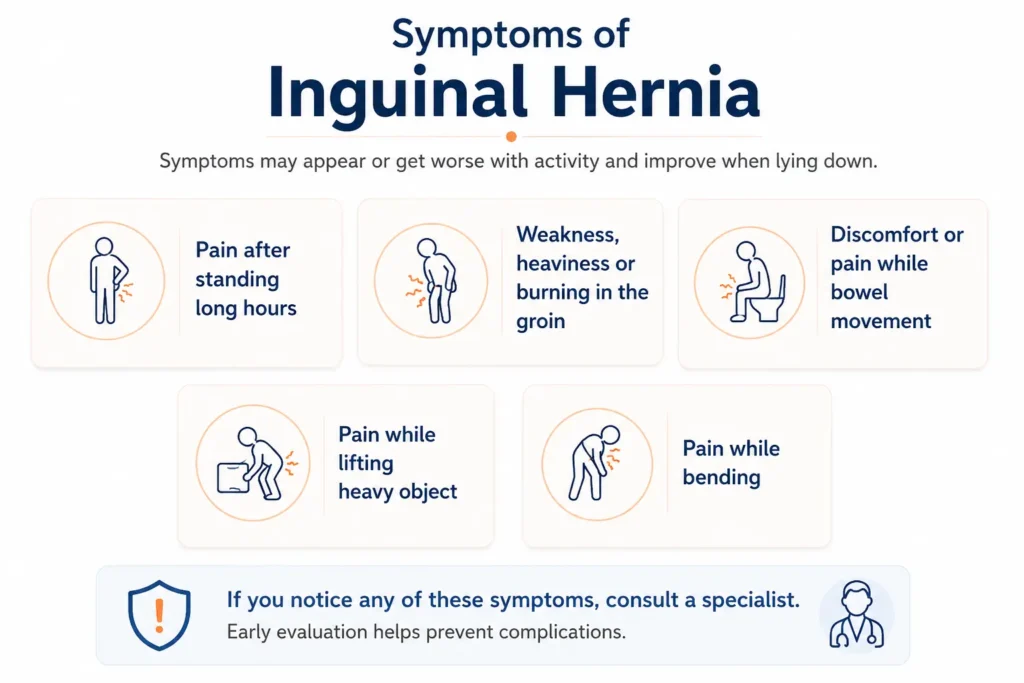
Symptoms can also include:
- A bulge in the groin
- Groin swelling
- A feeling of pressure or heaviness
- Burning or aching discomfort
- Pain while lifting or exercising
- Discomfort while coughing or straining
- A bulge that becomes smaller when lying down
Some inguinal hernias cause no significant pain; therefore, people often wonder when an inguinal hernia needs surgery. It is important to know that the absence of pain does not necessarily mean that a hernia should be ignored.
What Causes an Inguinal Hernia?
An inguinal hernia occurs because of weakness in the abdominal wall combined with pressure that pushes tissue through the weakened area.
Factors that may contribute include:
- Ageing
- Repeated heavy lifting
- Chronic coughing
- Constipation and repeated straining.
Some people also have a natural weakness in the groin area that makes an inguinal hernia more likely.
Being male, increasing age and a previous history of hernia can also increase the likelihood of developing an inguinal hernia.
How Is an Inguinal Hernia Diagnosed?
Most inguinal hernias can be diagnosed through a physical examination. Imaging such as an ultrasound may be recommended when the diagnosis is unclear or the hernia is not easily detected during examination.
During the consultation, the surgeon may examine the groin while you are standing, coughing or straining. This can make the hernia easier to identify.
An ultrasound may help confirm an inguinal hernia when the physical examination is inconclusive. CT or MRI may be considered in selected complex or unclear cases.
Early evaluation is useful because not every groin swelling is a hernia, and the treatment depends on the diagnosis.
Read More about Hernia Treatment in Delhi
Does an Inguinal Hernia Need Surgery?
Treatment depends on the size of the hernia, symptoms, reducibility, overall health and risk of complications. When surgery is recommended, the weakened area is repaired and may be reinforced with surgical mesh.
Some minimally symptomatic inguinal hernias may initially be managed with observation in appropriately selected patients. However, a painful, enlarging, difficult-to-reduce or complicated hernia requires surgical assessment.
An inguinal hernia does not usually close by itself in adults. If you notice a persistent groin bulge, consultation with an inguinal hernia surgeon in Delhi can help determine the safest treatment plan.
When Is an Inguinal Hernia an Emergency?
Seek urgent medical attention if a hernia suddenly becomes very painful, swollen, hard or difficult to push back, particularly if it is associated with nausea, vomiting or other significant abdominal symptoms. These can be signs of incarceration or strangulation and require prompt medical assessment.
Inguinal Hernia Treatment Options in Delhi
The main treatment options for inguinal hernia are open repair and minimally invasive laparoscopic repair. In selected patients, robotic-assisted repair may also be considered.
Laparoscopic Inguinal Hernia Repair
Laparoscopic inguinal hernia repair uses small incisions and a camera to repair the hernia from inside the abdominal wall.
It is a minimally invasive approach that may be suitable for many primary and recurrent inguinal hernias. Depending on the patient’s condition and the surgeon’s assessment, techniques such as TEP (totally extraperitoneal repair) or TAPP (transabdominal preperitoneal repair) may be considered.
Potential benefits of laparoscopic repair include smaller incisions and, in appropriate patients, a potentially quicker recovery compared with traditional open surgery.
Read More about Laparoscopic Surgery in Hindi
Open Inguinal Hernia Repair
Open hernia repair involves an incision over the groin. The herniated tissue is returned to its appropriate position and the weakened area is repaired, commonly using mesh reinforcement.
Open surgery remains an established treatment option and may be appropriate depending on the patient’s anatomy, medical history and type of hernia.
Robotic Inguinal Hernia Repair
Robotic-assisted hernia repair uses robotic instruments controlled by the surgeon. It may be considered for selected patients, including some complex or recurrent hernias.
Robotic surgery is not automatically the best choice for every patient. The appropriate technique should be decided after a detailed surgical evaluation.
Read More about Robotic Surgery in Hindi
Laparoscopic Inguinal Hernia Surgery: TEP vs TAPP
TEP and TAPP are two established laparoscopic approaches used for inguinal hernia repair. The choice depends on the patient’s hernia, previous operations and anatomy
TEP: The repair is performed in the preperitoneal space without entering the abdominal cavity.
TAPP: The surgeon enters the abdominal cavity to access the preperitoneal space and repair the hernia.
Both techniques can be effective when appropriately selected. A consultation is the best way to determine which approach is suitable for an individual patient.
Inguinal Hernia Surgery Recovery
Recovery after inguinal hernia surgery varies according to the surgical technique, the patient’s health and the complexity of the hernia. Many patients can walk soon after surgery and gradually return to normal activities.
After laparoscopic hernia repair, patients may experience temporary soreness, bruising or swelling around the surgical area. Light activity is generally encouraged, while strenuous activity and heavy lifting should be resumed according to the surgeon’s instructions.
Your recovery plan may include:
- Early walking
- Wound care
- Pain management
- Gradual return to work
- Activity restrictions
- Follow-up consultation
Learn about Hernia Surgery Recovery Timeline
Inguinal Hernia Surgery Cost in Delhi
Inguinal hernia surgery in Delhi generally costs between ₹35,000 and ₹2,50,000, depending on the surgical approach and hospital. Open repair may cost approximately ₹35,000 – ₹95,000, laparoscopic repair around ₹60,000 – ₹1,45,000, and robotic repair approximately ₹1,20,000 – ₹2,50,000. Government hospitals may have lower charges, typically around ₹5,000-₹25,000. (These are indicative market ranges and not a fixed quotation. The actual cost will be confirmed after clinical evaluation and depends on the procedure and individual patient requirements.)
The actual cost varies based on the type of hernia, whether it is unilateral or bilateral, surgical technique, mesh, hospital, anaesthesia, investigations and length of stay.
Patients searching for inguinal hernia surgery cost in Delhi may see different estimates because hospitals and procedures have different inclusions. Current Delhi listings also show substantial variation in laparoscopic and mesh-based hernia repair costs.
Why Trust Dr. Deep Goel for Inguinal Hernia Treatment in Delhi?
Dr. Deep Goel is a renowned laparoscopic and minimally invasive surgeon in Delhi with more than 27 years of clinical experience and 10,000+ surgeries, offering personalised surgical care at BLK-Max Super Speciality Hospital, New Delhi.
His surgical expertise includes minimally invasive procedures and complex gastrointestinal surgery. For patients seeking an inguinal hernia doctor in Delhi, the treatment plan is based on the type of hernia, symptoms, medical history and individual surgical requirements.
See Full list of conditions Treated by Dr. Deep Goel
Book an Inguinal Hernia Consultation in Delhi
If you have noticed a groin bulge, swelling, heaviness or persistent discomfort, an evaluation can help identify whether you have an inguinal hernia and whether treatment is required.
Dr. Deep Goel provides inguinal hernia treatment in Delhi, including laparoscopic and minimally invasive surgical options, based on individual patient needs.
Frequently Asked Questions
Can an inguinal hernia go away without surgery? expand_more
An adult inguinal hernia generally does not close on its own. Some minimally symptomatic hernias may be monitored in selected patients, but a surgeon should determine the appropriate management.
Is laparoscopic inguinal hernia surgery safe? expand_more
Laparoscopic inguinal hernia repair is an established minimally invasive surgical technique. Whether it is appropriate depends on the patient's health, hernia characteristics and surgical history.
How long does inguinal hernia surgery take? expand_more
The duration varies according to the type and complexity of the repair. Generally Laparoscopic (keyhole) or robotic approaches generally take between 45 to 90 minutes, while traditional open repairs often range from 30 minutes to over an hour.
Can an inguinal hernia come back after surgery? expand_more
Recurrence is possible after hernia repair, although modern repair techniques are designed to reduce this risk.
Can I walk normally after inguinal hernia surgery? expand_more
Yes. Most patients are encouraged to walk soon after inguinal hernia surgery, as tolerated, starting with short, gentle walks.
How to sit after inguinal hernia surgery? expand_more
After inguinal hernia surgery, sit upright with your back supported and avoid sudden bending or twisting.

Dr. Deep Goel’s Medical Content Team
Dr. Deep Goel’s medical content team specialises in creating accurate, clear, and patient-focused healthcare content. With strong clinical understanding and expertise in technical writing and SEO, the team translates complex medical information into reliable, accessible resources that support informed decisions and uphold Dr. Goel’s commitment to quality care.
This content is reviewed by Dr. Deep Goel
Related Conditions

Related Blogs
लेप्रोस्कोपिक सर्जरी (Laparoscopic Surgery) क्या है? फायदे, प्रक्रिया, खर्च और रिकवरी की पूरी जानकारी
क्या आपके डॉक्टर ने आपको लेप्रोस्कोपिक सर्जरी (Laparoscopic Surgery) कराने की सलाह दी है? यदि…
Read Article →
Hernia Surgery Recovery Timeline: What to Expect, Week by Week
Google says two weeks. Your neighbor says four. Your body might say something else entirely.…
Read Article →
Hernia Symptoms You Shouldn’t Ignore: A Guide to Early Detection and Care
A hernia often begins with a minor sign, perhaps a soft bulge in the abdomen…
Read Article → WhatsApp